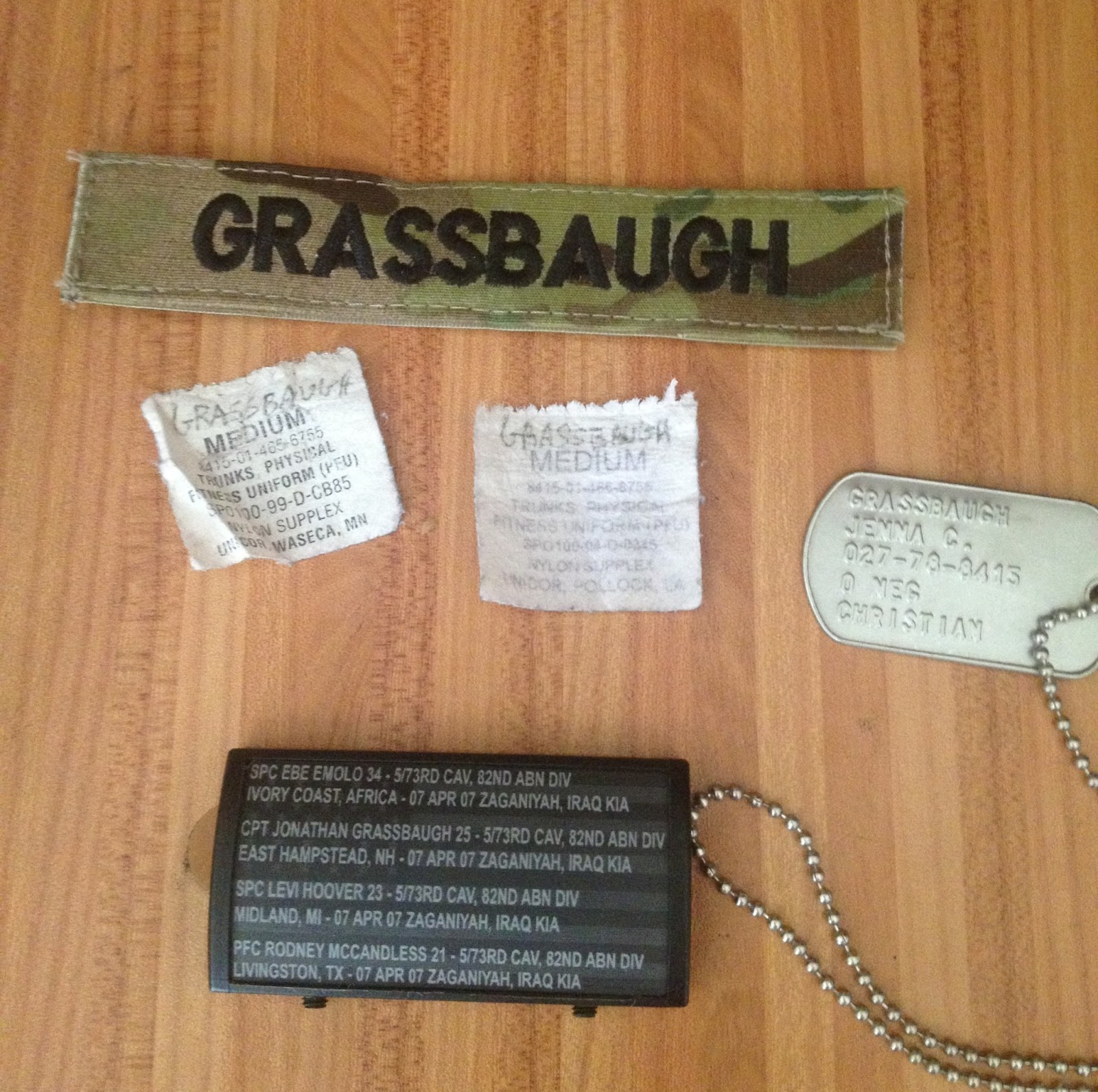
Although I'm not usually at a loss for words, I cannot adequately describe the whirlwind of incredible experiences I've been fortunate enough to enjoy this Veterans Day weekend. Perhaps I should simply let the record speak for itself; it will do justice to the events that have brought me to the brink of happy tears more than any words I might offer. On this Veterans Day 2013, I thank all my brothers and sisters from the bottom of my heart for your selflessness and sacrifice - this great nation owes you a debt of gratitude that can never truly be repaid:
MSNBC - "Taking the Hill" Panel on Remembrance:
http://www.msnbc.com/taking-the-hill/watch/the-influence-of-9-11-62748227554
ABC/FoxNews - "Good Day Columbus" Interview:
http://abc6onyourside.com/shared/news/features/good-day/stories/wsyx_monday-veteran-featured-cosmopolitan-magazine-6021.shtml#.UoFNgKXHJfM
Tiffin University - Veterans Day Ceremony Speech:
Today is Veterans Day. Though sometimes confused with Memorial Day, today is about service. It’s about thanking a veteran for their sacrifices and rejoicing in the fact we are all fortunate to live in a great country where our freedom is attributable to selfless service. It’s been said that, “war has a way of distinguishing between the things that matter and the things that don’t.” You can ask any veteran if that’s true, and no matter what his or her experiences in the military have been, I can guarantee you the answer will an emphatic yes.
My name is Jenna Grassbaugh, and I’m a third year law student at the Ohio State University Moritz College of Law. I’m also an active duty Army Captain, a veteran of the wars in Iraq and Afghanistan, and the proud Gold Star wife of another veteran, a veteran who taught me to recognize what matters and what doesn’t. That veteran, my late husband, Captain Jonathan Grassbaugh, lived by the motto “non sibi,” – “not for oneself.” He told me that despite the challenges life, law school, and the future might bring, at the end of the day, what mattered was that we had each other. He promised he would love me through the best of the best times and the worst of the worst.
He was standing at a pay phone in Iraq when he uttered these words. You see, six weeks after we were married, he was deployed for a second time with the 82nd Airborne Division. Ten months after our wedding, on April 7, 2007, two Army officers knocked on my door to tell me that Jon had been killed by an Improvised Explosive Device in Zaganiyah, Iraq. Despite our hopes of starting a family and growing old together, our dream was not to be. Jon was twenty-five years old when he died.
During a trip home from Washington, D.C. last year, I was at Reagan Airport for an early morning flight and, as usual, I had over-packed. As I checked my heavy bag in at the ticket counter and then hoisted it up onto the screening belt, I was struck by a sudden sense of déjà vu. I've been here before, I thought. This all seems incredibly familiar. It was in that moment that I remembered lifting a similar bag up onto the same conveyor belt over six years ago as I prepared to leave D.C. after Jon's funeral. On that first trip, I felt weighed down - both physically and emotionally. Leaving my husband's body behind was hard enough; contemplating what on earth to do with the rest of my life seemed unimaginable. My bag was heavy and full, only instead of clothes and shoes, it contained things like a wooden flag box, a folded American flag, brass casings from the 21-gun salute, and a plastic container full of all the letters Jon had ever written me. I was a 22-year old widow going home, only I didn’t know where home was without Jon. It was the worst of the worst times, and I had to navigate them without the one person I knew could show me the way.
Over these past six years, I’ve tried so many different things to overcome this tragedy, though I don't think you ever truly “get over” the loss of someone who made this world a better and brighter place. I withdrew from my first year of law school at William & Mary and threw myself into my Army career. I deployed to Iraq as a Military Police platoon leader. I ran races to raise money for organizations that help the families of fallen soldiers. Eventually, I realized I still wanted to serve in the Judge Advocate General’s Corps, and I applied to the Army’s Funded Legal Education Program. I began law school again – this time at Ohio State. It wasn’t until last fall, however, that I realized there might still be more I could do to turn my worst nightmare into a positive good. I realized I had the power to ensure that Jon’s belief in selfless service would live on into perpetuity and that I could help others in need in the process.
Here in the state of Ohio, there are more than 900,000 veterans. As I’ve discovered, not everyone understands exactly what constitutes a veteran or can appreciate the kind of unique legal issues they often face after returning home from what might be their first, second, or even fifth deployment. A veteran is anyone who has served overseas during a time of war. It is not, necessarily, the forty-five-year-old Colonel who retires with full benefits after twenty years. Instead, it might very well be the Staff Sergeant who served two tours in Iraq, one in Afghanistan, and then separates from the Army with child support payments, debt issues, and severe post-traumatic stress disorder. The more research I did, the more the problems facing veterans caused me concern. The Legal Aid Society of Columbus is overwhelmed by a caseload that requires specialized knowledge and expertise, and, as of last fall, there was no central location to which Ohio's veterans could go for help.
With this knowledge, I started brainstorming ideas for how to go about providing free legal services for veterans. I realized that Ohio State did not have a clinic dedicated to tackling veterans’ issues, and I decided it was time to change that reality. I'd also reached a rough point personally in dealing with some of the issues associated with Jon's death, many of which I think I'd more or less suppressed up until that point. My hopelessness at how to deal with things completely beyond my control gave me the motivation I needed to do something more tangible with the time and resources I had at my disposal. On October 26, 2012, I attended a Veterans Wraparound Summit hosted by former Ohio Supreme Court Justice Evelyn Stratton, which provided me with the tools I needed to understand the complexities of the legal issues facing veterans. From there, I used the models of several preexisting clinics at other law schools around the country to approach the Moritz faculty with an informal proposal for a similar project. After much discussion and compromise, we agreed on a basic structure for the program: the Captain Jonathan D. Grassbaugh Veterans Project would pair veterans with law students to help them sort through their legal issues and find solutions. Practicing attorneys – many current JAG lawyers in the Ohio National Guard – would volunteer to supervise the student work.
I donated the seed money, endowing the fund with $250,000 of the insurance funds I received upon Jon's death, and the law school is currently engaged in a fundraising drive to match that amount. This will ultimately enable us to provide 2,000 hours of free legal services to veterans annually. The Captain Jonathan Grassbaugh Veterans Project was officially launched on April 5, 2013, just two days before the sixth anniversary of Jon's death. The project is up and running today, and Moritz students are actively assisting veterans as we speak.
I can honestly say that it was not until I founded the Grassbaugh Veterans Project that I finally felt a sense of real peace and happiness. The mission of the project means more to me than any material thing that money could ever buy. This is Jon’s legacy and it’s one that will go on long after I’m gone too. It means that my other very worst fear will not come true – that being that, in time, he’ll be forgotten.
Ironically, in the military, one person can feel very insignificant—success in combat depends on countless people at various times during multiples phases of a carefully-planned operation. The military is practically the poster child for the concepts of “communication” and “interaction” and “teamwork,” which is probably why the “Army of One” slogan didn’t do quite as well as “Be All You Can Be” or even “Army Strong.” The reality, however, is that without one person doing their job and playing their part, military precision breaks down. One person can make a difference – a big one. One person can have a vision for how to save lives or how to improve the status quo, and provided they can rally an army of supporters, so to speak, that vision can become a reality.
So, despite being cautioned against doing anything too drastic or giving away too much money, my stubborn determination to make the Grassbaugh Veterans Project a reality will ultimately, I hope, make a meaningful difference in the lives of others – others who have already given so much and sacrificed time away from their families and the safety of home to deploy overseas and fight for our freedom. Quite frankly, I never second-guessed my decision to pursue this vision or doubted the need see it through to completion. I was overwhelmed at the university’s support for the concept once I was able to demonstrate how we might make it happen. And once we got the ball in motion, it didn’t stop. I would have been happy to see this project become a reality by, say, the time I graduate in May of 2014. Instead, by the time I graduate, the project will have been up and running for an entire academic year, and law students will have helped to fight countless legal battles on behalf of veterans. It wasn’t a miracle, and I didn’t do anything extraordinary or superhuman. I just did what I thought was the right thing to do. This project is my attempt to identify and address veterans’ legal issues at a time when we can still prevent the worst of the worst from befalling our nation’s heroes.
A couple of weeks ago, I returned to Washington, D.C., a bittersweet place for me, and ran my fourth Army Ten Miler race. The course winds through the entire city, past the Smithsonian Museums and national monuments, across Memorial Bridge via Arlington National Cemetery, and ends back where it began at the Pentagon. I ran to raise money for Fisher House, the organization that came to the government’s aid during the recent shutdown when it provided funds to families of fallen soldiers to cover funeral costs and travel expenses. Later that weekend, I spoke at an event overlooking Arlington National Cemetery, where those who served our nation with dignity and honor are laid to rest – including Jon. At Arlington, Jon rests amongst many heroes, all of whom believed in the importance of selfless service and gave their lives to that end. Each of these heroes represents just one person, but one person who meant the whole world to their loved ones and left a lasting impact during their short lifetime. President Abraham Lincoln said that it’s not the years in a life – it’s the life in the years. Jon didn’t have the luxury of many years, but he was one person who managed to achieve so much and represented so many wonderful things: he was an Army Ranger. A Patriot. Leader. Friend. A loving husband. He made me a better person – and he still does.
Today is about the kind of selfless service in which Jon and all the soldiers he served alongside believed wholeheartedly. The Grassbaugh Veterans Project seeks to honor that selflessness and sacrifice by helping those who return home from war to live better and happier lives. The project is about distinguishing the things that matter from the things that don’t. Thank you to all veterans for what you have done and continue to do on behalf of all of us. You matter, and we are forever grateful.